This article is adapted from a March 18 2026 discussion between two partners at iOne Capital regarding the latest round of conflict among the United States, Israel, and Iran. The discussion covers the historical, political, and military context of the three countries. The original video is available on our video channel.
I. Origins of the War
Liu: The U.S. and Israel have been conducting airstrikes against Iran for nearly two weeks. There is a great deal of noise online. To help our investors and readers develop a more comprehensive and deeper understanding of how this war unfolded, we should analyze it from three angles: its historical origins, the current state of the conflict, and its likely future trajectory. This will also help us better understand the implications for the global economy and financial markets.
Let’s start with the origins of the war. There are two popular narratives online. One says the U.S. was dragged into this war by Israel. The other says Trump himself had already intended to launch this war. How do you view this question?
Fan: I think both narratives contain some truth, but neither is complete. To fully understand the origins of the war, we first need to understand why Iran and Israel went to war in 2025, and why the U.S. bombed Iran’s nuclear facilities.
Liu: My understanding is that Iran was approaching a critical breakout window in its nuclear program. It was only weeks away from being able to enrich uranium to weapons-grade levels. Israel viewed this as an existential threat and therefore believed it had to act preemptively.
Fan: That is indeed the main reason. Iran’s theocratic faction has long regarded Israel as its mortal enemy and has sought to erase Israel from the map. Anti-Zionism and hostility toward Israel have been part of the ideological foundation of the Iranian regime. I assume readers are familiar with this historical background, so I will not repeat it in detail.
All of Israel’s major regional adversaries — Hamas and Hezbollah in Lebanon — have been sponsored and trained by Iran. After the Gaza war broke out in October 2023, Israel inflicted severe damage on Hamas and Hezbollah throughout 2024. This significantly weakened Iran’s regional deterrence.
In early June 2025, the International Atomic Energy Agency accused Iran of violating its nuclear non-proliferation obligations. At that point, the Netanyahu government concluded that, with Iran’s proxy network weakened and its nuclear program nearing a critical breakout point, Israel had to make an all-out effort to contain Iran. That led to a large-scale preemptive strike.
However, Israel by itself did not have the capability to destroy Iran’s deeply buried nuclear facilities. Since Israel and the U.S. shared a common interest in containing Iran’s nuclear capability, the U.S. joined the military operation and destroyed the underground nuclear facilities.
Trump has historically been restrained when it comes to war. After destroying the nuclear facilities, he immediately moved toward ceasefire negotiations. But that war marked a formal transition in the U.S.–Israel–Iran conflict: from a proxy war to direct confrontation.
Liu: But this time the U.S. has launched a much larger operation, which is very different from the 2025 military action. Trump has always branded himself as a peace president, with mediating the Israeli–Palestinian conflict and the Russia–Ukraine war as key geopolitical priorities. He and his Republican advisers also know that a Middle East war would push up oil prices, which would be unfavorable for the midterm elections. So why did his attitude toward Iran change so dramatically in February? It feels as though there must have been major stakes involved for him to take such a risk.
Fan: That is indeed a very important question. Understanding this contradiction is crucial to understanding where the war may go next.
We need to look at this from several angles.
First, Iran. Although the 12-day war in 2025 severely damaged Iran’s nuclear facilities, it did not completely destroy Iran’s industrial base or its capacity for missile retaliation. After its nuclear facilities were damaged, Iran realized that its conventional deterrence had failed. Instead of backing down, it became even more determined. It did not stop enriching its remaining nuclear material and also significantly expanded production lines for drones and ballistic missiles.
During the 12-day war, Iran discovered that saturation attacks could effectively paralyze air defense systems. As a result, its strategic focus shifted from improving the precision of individual weapons to maximizing output. The objective was to use numerical superiority to create a sustained threat against U.S. military bases in the Gulf region and Israeli cities.
According to U.S. government intelligence, by February of this year, Iran’s annual drone production capacity had exceeded 140,000 units, and it had already stockpiled 80,000 drones. Its ballistic missile stockpile had exceeded 2,500 missiles.
Liu: Iran is a large country with a population close to 100 million, while Israel has only about 10 million people. At that production rate, Iran does not need better technology than Israel. It simply needs to keep launching weapons and overwhelm Israel by volume. If Israel cannot stop Iran’s nuclear development, it becomes an existential crisis for Israel.
Fan: Exactly. Another factor is that Iran’s economy is in extremely poor condition, and public dissatisfaction with the regime has continued to deepen. In January, there were large-scale demonstrations and violent crackdowns, and the domestic political situation became highly unstable. Israel saw this as an opportune moment and decided to launch a full-scale strike to eliminate the threat.
Liu: Does the U.S. face a similar threat?
Fan: The threat Iran poses to the U.S. itself is limited. The U.S. homeland is geographically far from Iran, so even if Iran possessed nuclear weapons, it would not be able to strike the U.S. mainland. Although the Iranian regime has long referred to the United States publicly as the “Great Satan” and called for its destruction, in reality the U.S.–Iran relationship is not existentially adversarial in the same way as the Israel–Iran relationship. There is still room for diplomatic maneuver.
Liu: If that is the case, why did the U.S. join the war?
Fan: There are two important factors.
The first is Israel. Trump knew that once Israel attacked Iran, the U.S. could not simply stand by. It would inevitably help Israel defend itself. Politically, it is almost impossible for the U.S. to remain completely uninvolved. Iran would certainly attack U.S. military bases in the Middle East.
Because Israel was likely to launch an unprecedentedly intense strike, if Iran and Israel entered an all-out exchange and the U.S. only assisted defensively, then given Iran’s missile production trajectory, Israel would find it difficult to withstand the pressure. U.S. air defense systems in the region — including THAAD and Patriot systems — could face ammunition depletion within months under Iranian saturation attacks.
Liu: In other words, once Israel launches an attack, unless the U.S. fully distances itself from Israel, it has effectively already been pulled into the war.
Fan: Yes. And the political reality in the U.S. is that almost no president can refuse to help Israel. Pro-Israel constituencies and advocacy groups have significant influence in American politics, and Trump is no exception.
Liu: Not to mention that Trump’s son-in-law is Jewish, and he was also involved in negotiations with Iran.
Fan: Yes. From that perspective, it was essentially impossible for Trump not to participate in the war.
Liu: I remember that Secretary of State Rubio seemed to inadvertently reveal in an interview that the U.S. entered the war partly because of Israel’s needs. It felt as though he misspoke, which is why reporters repeatedly pressed him afterward.
Fan: That did happen. But Israel was probably not the whole reason Trump decided to attack Iran. Judging from Trump’s historical words and actions toward Iran, he himself also had a strong desire to strike Iran.
Liu: How should we understand that?
Fan: Based on Trump’s overall response to negotiations with Iran, he believed Iran would not stop developing ballistic missiles or nuclear weapons. In fact, the situation supported that view. One principle in his “Art of the Deal” approach is to judge whether the counterparty is negotiating in good faith. If he believes there is no sincerity, he chooses not to negotiate and instead applies maximum pressure until the other side compromises.
In fact, decades ago, when he was still in his thirties, Trump already held this view toward Iran. He believed Iran had no respect for the U.S. and therefore that negotiations were futile.
Over the past few weeks, we have repeatedly seen this central idea in interviews and social media posts: for 47 years, Iran has never truly respected the United States and has continuously created problems for America’s Middle Eastern allies, increasing the burden on the U.S. Trump therefore wants to use this military operation to fundamentally destroy Iran’s geopolitical influence in the Middle East.
Liu: I remember that Obama negotiated with Iran before. At the time, Iran formally agreed not to develop nuclear weapons, and Obama lifted economic sanctions. But after Iran received the money, it used resources externally to support Hamas and Hezbollah, and internally accelerated research into ballistic missiles and nuclear weapons. Looking back, the establishment approach represented by Obama’s negotiations with Iran remains controversial in terms of its effectiveness with this regime.
Fan: Yes. Trump has recently said many times that if he does not thoroughly destroy Iran’s military capability, Iran will create trouble again every two years. No president in the past did it, and perhaps no president in the future will do it. But Trump does not want the U.S. to have to deal with Iran’s problems indefinitely. So he decided to end the matter.
Liu: That sounds almost like a sense of mission — as if he believes he must be the one to take on this burden. From that perspective, he seems to be trying to shape his political legacy, hoping future generations will recognize him as a president who changed the structure of the Middle East.
Fan: That is one way to put it. We know Trump very much wants to facilitate a peace agreement in Gaza. Iran is the financial backer behind Hamas, Hezbollah, and the Houthis. It may be the only country in the Middle East that does not want such a peace agreement to happen.
Iran, as a theocratic state, also has poor relations with America’s more secular Middle Eastern allies, such as Saudi Arabia and Qatar. While these U.S. allies may appear on the surface to have difficult relations with Israel, that is largely political correctness. Their underlying interests are aligned: they all want stability and prosperity.
So, in Trump’s view, he has ample reason to believe he is acting in the service of a historical contribution to peace in the Middle East.
Liu: Many people argue that the strategic objectives of the U.S. and Israel in this war are unclear. At one moment, the stated objective is eliminating nuclear weapons; at another, it seems to be regime change. What is really going on? Or is it simply chaotic?
Fan: That is an excellent question. In the U.S., this issue has been overinterpreted by partisan media. In fact, Trump’s position from the beginning has been relatively simple. The objective of striking Iran is to destroy Iran’s military-industrial system. In plain English, the goal is to push Iran’s geopolitical and military capabilities back dramatically, so that Iran can no longer pose any meaningful threat to other countries in the Middle East.
Specifically, this includes eliminating Iran’s air force and navy, destroying its ability to produce and launch ballistic missiles and drones, and destroying its nuclear capability.
Liu: Many people are discussing regime change. Has Trump made regime change an objective?
Fan: This is an important question because it directly determines how long the war may last. In fact, from the beginning, Trump has not made regime change a U.S. military objective. Trump himself, as well as the Secretary of State, the Secretary of Defense, and others, have stated clearly on multiple occasions that regime change is not the military objective of the United States.
At the start of the war, Trump posted on social media encouraging the Iranian people to overthrow the regime. That may have given people the impression that regime change was his primary objective. But in reality, that was more of a psychological tactic. Based on the words and actions of Trump and the White House, regime change in Iran is something they would like to see, or a potential upside, but it is not the military objective they are trying to achieve.
Trump is ultimately a realist. Looking at his historical pattern of behavior, he has a relatively clear understanding of what he can and cannot do. I believe what he most wants is for Iran to replace its leadership with a more pragmatic faction that can negotiate with him and accept the terms he offers.
Liu: Venezuela is indeed an example. Trump did not intend to overthrow the Venezuelan regime. Rather, he wanted to replace the leadership with someone who could negotiate and coordinate with him. But we should emphasize that Iran is a religious state, unlike Venezuela’s dictatorship. In Venezuela, one could theoretically remove a dictator and create a power vacuum, then support pragmatic factions in negotiations. Iran is a theocratic system with collective leadership. Decapitating the senior leadership means going to war with the entire religious governing structure. Hoping for a pragmatic faction to emerge in Iran seems almost unrealistic.
Fan: That is a clear distinction. I do not think Trump is unaware of the differences between Venezuela and Iran, given that he has negotiated with both countries. According to U.S. intelligence, there are also different factions within the Islamic Revolutionary Guard Corps. For example, the current foreign minister comes from the Revolutionary Guard background, yet has shown relatively more flexibility in negotiations.
Trump’s focus is on finding someone who can accept his terms. His objective is security and interests; he has no ideological obsession. Unfortunately, Israel’s decapitation strikes were so extensive this time that some of the figures they had originally believed could become negotiating candidates were also killed. So that objective is currently not achievable.
Liu: What about Israel? Is regime change its objective?
Fan: I believe Israel has a stronger motivation than the U.S. to achieve that objective, because Israel certainly does not want this regime to remain in power. In the specific military operation, we can clearly see that Israel has been responsible for comprehensive decapitation strikes against the senior leadership of the Revolutionary Guard. The U.S. has mainly focused on destroying physical targets such as missiles, naval assets, and military-industrial infrastructure.
But Israel knows that whether it can achieve this military objective depends heavily on the U.S. Judging from recent interviews with multiple Israeli officials, their stated timeline is that current military operations will continue for roughly another three weeks. This messaging is broadly consistent with that of the U.S. The Israeli defense minister has also publicly stated that Iran’s political future can only be decided by the Iranian people. So at least in the near term, regime change is not their primary stated objective.
My view is that Israel’s most practical objective is likely to conduct five to six weeks of strikes, ensuring that Iran’s direct military threat and proxy threat are neutralized, while also creating some necessary conditions for possible regime change. What happens after that is something they will assess later.
II. Current Progress of the War
Liu: If the objective is to destroy Iran’s military-industrial system and eliminate its ability to pose a geopolitical threat, how has the war progressed over the past two weeks? Has everything gone according to U.S. and Israeli expectations?
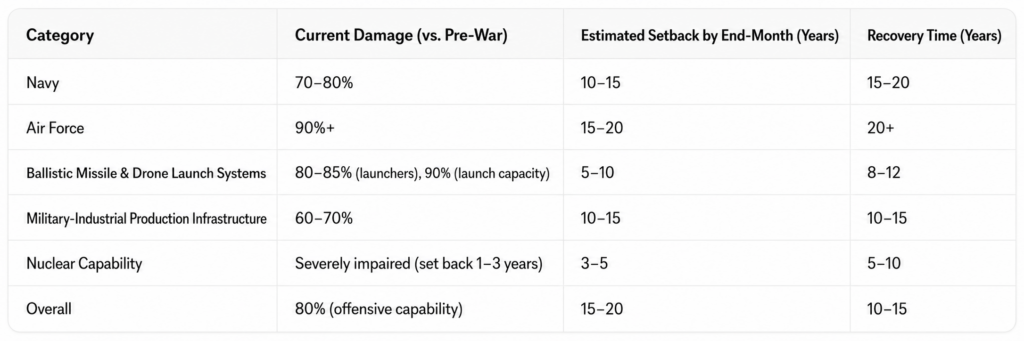
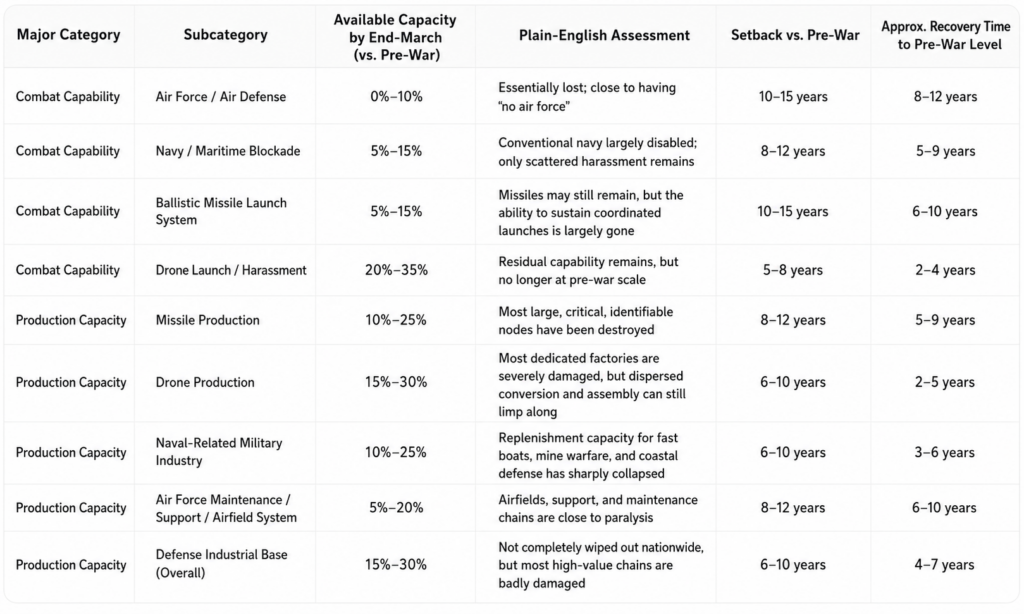
Fan: In terms of that military objective, there is no doubt that the U.S. and Israel have exceeded expectations so far. We asked AI to create a summary based on reliable military intelligence, giving a framework-level assessment of the degree to which Iran’s combat capabilities and resources have been damaged. We also asked it to estimate, based on the current military trajectory and assuming the campaign proceeds as expected through the end of the month, how far Iran’s various military capabilities may be set back and how long recovery may take.
I should emphasize that this is only a quantitative framework produced by AI. The purpose is not precise prediction, but to help readers form a broad understanding of Iran’s current losses.
Grok:
ChatGPT:
Gemini:
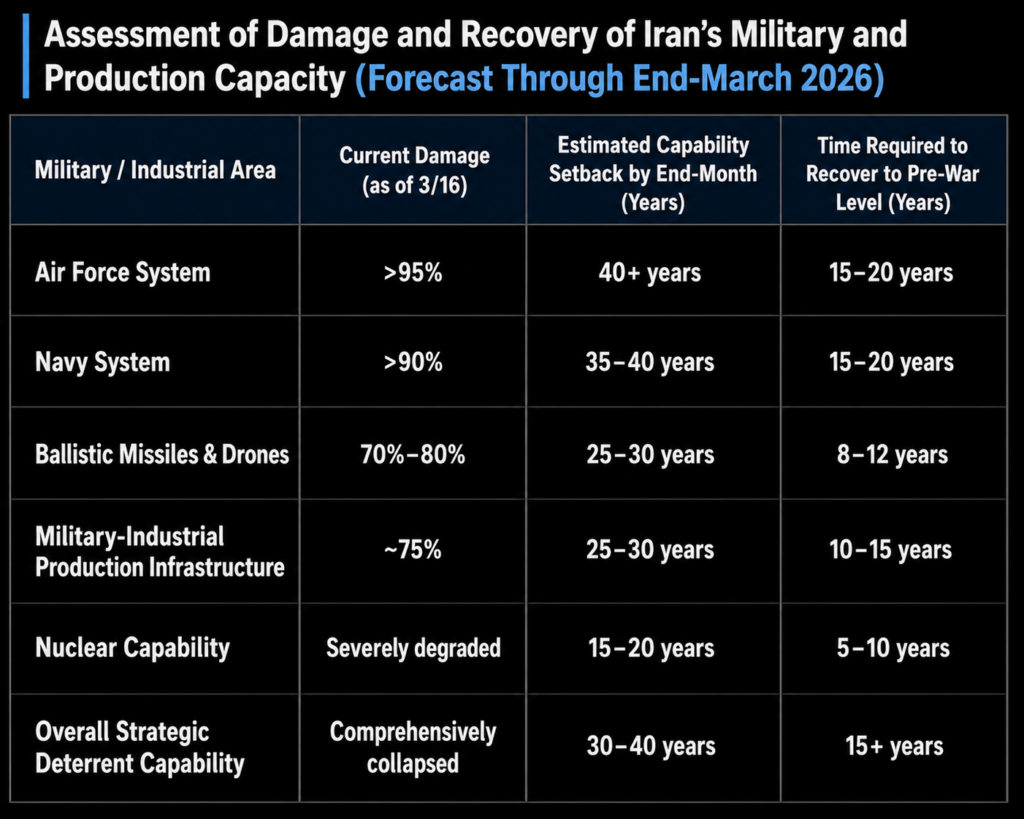
Across all three AI assessments, Iran appears to have suffered severe setbacks across multiple dimensions, significantly exceeding the damage seen in prior wars or shocks.
From this perspective, as Trump has said, this round of military strikes has indeed been executed better than expected.
Liu: What will the U.S. military plan look like from here? Also, many reports say the U.S. has consumed a massive amount of ammunition in this campaign. Could that lead to supply shortages later?
Fan: Based on the current battlefield situation, U.S. operations have shifted from initial saturation attacks to targeted precision strikes. Most of Iran’s remaining combat capabilities are now hidden inside mountains, underground facilities, or civilian infrastructure. Its actual launch capability is now under 10% and continues to weaken.
The U.S. did consume a large quantity of expensive munitions during the first two weeks. But the situation has changed. From an offensive perspective, the campaign is now primarily based on low-intensity precision strikes. Most of the munitions being used have shifted toward medium- and lower-end weapons with ample inventory, such as drones and bombs. The objective is to destroy remaining military bases, hidden exits, and production facilities.
From a defensive perspective, the U.S. is also shifting toward lower-cost drone interception, laser interception systems such as HELIOS, rockets, cannons, and electronic jamming. The purpose is to neutralize Iran’s sporadic offensive disruptions.
Liu: So the core logic is that because most of Iran’s combat and production capabilities have already been destroyed, the U.S. no longer needs high-intensity offense or defense, which significantly reduces supply pressure.
Fan: Yes. Another core U.S. objective, which is widely known, is to clear military obstacles in the Strait of Hormuz in preparation for future escorts or passage. At present, the U.S. is clearing Iran’s remaining missile and drone launch facilities, especially along the coast. At the same time, the U.S. has deployed an amphibious ready group and Marines toward the Middle East. Their purpose is to provide close protection for oil tankers, establish a low-altitude no-fly zone, and strike or destroy Iranian military capabilities over and along the Strait.
Liu: The Strait of Hormuz has still not reopened. I think Trump may have underestimated Iran’s control over the Strait.
Fan: Yes. For the U.S., there have been two negative surprises in this war.
The first is that Washington did not expect Iran to strike neighboring countries — America’s Middle Eastern allies — so aggressively. Iran has attacked not only U.S. military bases and embassies in these countries, but also civilian facilities, including airports, energy facilities, data centers, ports, and residential areas. Because these countries have defense systems, such attacks have not caused significant military damage, but they have had a meaningful impact on commercial activity and therefore on their economies.
The second is Iran’s full blockade of the Strait of Hormuz. The military certainly evaluated this risk, but it may have underestimated the deterrent effect of Iran’s asymmetric threats on commercial shipping. After all, even if a single mine or missile hits an oil tanker, global insurers could collectively withdraw. So compared with purely military risk, commercial and economic risk is the more fundamental issue.
Liu: These two points are also the focus of current debate among media and experts. I have seen many pessimistic forecasts. For example, Professor Mearsheimer’s analysis suggests that Iran’s current strategy is very smart, because both points rely on asymmetric threats to wage a war of attrition. Iran does not need large-scale attacks. Sporadic attacks are enough to create economic damage for the Middle East and the world, which puts considerable pressure on the U.S., especially with midterm elections approaching. Therefore, the argument goes, the U.S. may ultimately lose the war because it cannot stop these two dynamics.
At present, America’s Western allies do not seem helpful. They are unwilling to join the war and will not escort ships unless military risks are eliminated. So the U.S. and Israel have not received any substantive assistance in the Strait of Hormuz.
In addition, domestic U.S. polling shows that most Americans do not support this war. Many conservatives who originally supported Trump have also expressed dissatisfaction. Trump may therefore be forced to withdraw from the Strait and lose control of Hormuz.
How do you assess these arguments?
III. Future Trajectory
Fan: Your analysis touches on the core contradictions facing the White House. Each of these issues creates pressure. But when I think carefully about each one, I see a common assumption behind all of these concerns: that this war will become a prolonged, high-intensity drain on the U.S. and its Middle Eastern allies.
In reality, I believe the probability of that assumption holding is low — perhaps very low.
We can analyze this from three perspectives: the U.S. and Israel, Iran, and Middle Eastern allies. We should also combine military and political logic.
Let’s start with the military dimension.
Trump is actually right that the U.S. has already won this war militarily. As the AI analyses suggested, Iran’s navy, air force, missile systems, nuclear program, and military-industrial production capacity have all been massively destroyed or set back. That is not seriously disputed.
From the perspective of Middle Eastern allies, although they have been hit by various Iranian military strikes, and although these attacks have had a significant short-term psychological impact on local populations, the reality is that defense systems have successfully intercepted the overwhelming majority of threats. The actual level of destruction has been fairly manageable.
These countries have now moved from passive interception to active burden-sharing and defense upgrades. According to various think tank and media analyses, over the next one to three months, these countries will accelerate procurement and upgrades of defense systems to improve efficiency and reduce costs. For example, they are adopting Ukrainian drone technology as well as laser defense weapons.
Although these countries rely heavily on U.S. defense systems, they are not without their own combat capability. They have not joined the U.S. strikes on Iran mainly because, given overwhelming U.S. offensive superiority, they do not see the need to take the risk of formally going to war with Iran.
Liu: I have seen several media reports saying that these countries are currently pressuring the U.S. to eliminate Iran’s military capability as quickly as possible so they can restore safe passage.
Fan: Yes. Moreover, Israel’s decapitation strikes against Iran’s senior military leadership have been highly deterrent and have severely disrupted Iran’s ability to maintain unified and effective strategic command. From the actual battlefield situation, Iran has basically lost the ability to conduct systematic, unified operations. Here I mean the ability to concentrate forces for large-scale saturation attacks.
So from a military perspective, the assumption of “long-term, high-intensity attrition” no longer holds. Iran’s military has now degraded into scattered guerrilla-style capabilities. Its only remaining leverage is the Strait of Hormuz, where it can use asymmetric advantages to create deterrence.
But that advantage is also weakening. Based on multiple sources of military intelligence, given the pace at which U.S. and Israeli forces are conducting targeted strikes against Iran’s remaining military capabilities, and considering that in about a week the U.S. amphibious ready group and Marines will be deployed in place, U.S. operational capability around the Strait and coastline will further improve. It is reasonable to infer that, with high probability, the U.S. will be able to conduct a small-scale trial escort before the end of the month.
Because such an escort would carry major political significance, Iran would likely strike hard to avoid appearing weak. That, in turn, would expose its remaining combat capabilities. The U.S. and Israel would use that opportunity to destroy or significantly weaken those residual forces, improving the safety of subsequent escorts.
Liu: So from a military and technical perspective, a successful escort within the next two weeks is a high-probability event. This also aligns with the remaining timeline indicated by the Pentagon and Israeli military. If the U.S. can ensure the military safety of escorts and allied bases, Iran’s initiative would be completely lost. Under that scenario, Iran may be forced back to the negotiating table.
But we still need to observe the actual situation. The U.S. military has been very cautious and has not relaxed its assessment of high risks in the Strait. If two weeks from now the U.S. finds that it still cannot effectively escort vessels, or that safe escorting cannot be achieved in the near term, then the Strait of Hormuz would enter a stalemate. That would be a situation neither the U.S. nor its allies want to see.
Fan: That scenario is theoretically possible. But I believe that, contrary to the intuition of many media commentators, whether or not the U.S. conducts escorts over the next two to three weeks, Trump still has the option to exit the war immediately — and once he exits, the Strait would most likely reopen naturally.
Liu: How exactly does that logic work?
Fan: This brings us to the second level of analysis I mentioned earlier: political logic.
Let’s first look at the U.S. political landscape. As we discussed earlier, a prolonged stalemate runs counter not only to Trump’s policy preferences, but also to the majority of U.S. public opinion. It also conflicts with the interests of Middle Eastern allies. At the same time, after two more weeks, the U.S. will indeed have achieved the military objectives Trump announced: Iran and its proxies will have suffered a major decline in regional deterrence. From this perspective, Trump can absolutely declare victory and withdraw.
The concern most people have is whether, after a U.S. withdrawal, Iran would continue occupying or blocking the Strait of Hormuz, resulting in a long-term blockade.
Liu: That is indeed the core market concern.
Fan: To address that, we need to analyze the political logic from the perspectives of Iran, Middle Eastern allies, and the rest of the world.
Iran’s current regime is essentially maintained by the Islamic Revolutionary Guard Corps. Khamenei’s son is merely a figurehead elevated by the IRGC. Although the IRGC appears highly unified on the surface, in actual execution it has become fragmented, with different units seeking their own survival. Because resources have been destroyed or blocked, different IRGC units have begun requisitioning civilian resources and competing intensely with Iran’s regular army for resources. Early signs of warlordization are beginning to appear.
In such an extremely unstable political environment, if the U.S. military withdraws, the current Iranian regime would first need breathing space. Otherwise, it would face further internal fragmentation, popular resistance, or even regime collapse.
On the other hand, after a U.S. withdrawal, if Iran does not stop and instead continues obstructing passage through the Strait, the result would be equivalent to formally declaring war on Middle Eastern allies, Europe, and other countries. Logically, Iran should seek to improve relations with other countries and avoid complete isolation. Its current attacks on neighbors are a reluctant strategic choice, not a sustainable long-term strategy.
Therefore, from both internal and external perspectives, the only strategy consistent with Iran’s interests would be to loudly declare victory, claim it drove the U.S. out, reopen the Strait, and ease relations with neighboring countries.
Liu: That is a rational cost-benefit analysis. But wars are sometimes irrational. Could Iran retaliate by continuing to block the Strait in order to push up oil prices and U.S. inflation as revenge against Trump? Russia might also benefit from higher oil prices, as they would increase its revenue, ease the impact of international sanctions, and reduce pressure on the battlefield in Ukraine.
Fan: Yes. If that happens, we would need to analyze the situation case by case. As a macro reference point, according to Goldman Sachs research, every sustained 10% increase in oil prices reduces growth by 0.1 percentage point, while increasing headline inflation by 0.2 percentage point and core inflation by 0.04 percentage point. Temporary price spikes have roughly half that effect.
Liu: Could Iran selectively block only the U.S., thereby affecting the U.S. economy and international influence?
Fan: First, if we examine U.S. dependence on imports through the Strait of Hormuz and the availability of substitutes, we find that U.S. dependence is actually quite low. Second, I think the probability of a unilateral blockade against the U.S. is also low.
If the U.S. is going to withdraw, it would most likely give Iran an exchange condition: passage must be restored. The other side of that condition is deterrence. For example, Trump could say: if I withdraw and you continue to block the Strait, I can directly destroy all of your energy and power infrastructure, or I will intercept all goods you export through the Strait of Hormuz.
Based on our earlier analysis of Iran’s political costs and benefits, this would be an attractive condition for Iran. The regime needs that window to breathe and repair itself. Otherwise, the U.S. only needs to leave some naval vessels in the Gulf region to conduct sustained low-intensity strikes, combined with Israeli strikes, and that would create enormous pressure on the Iranian regime. For the U.S., those would be low-cost strategies.
Moreover, if Iran and the U.S. engage in military friction in the Strait of Hormuz, because the Strait is so narrow, it would obstruct passage for all other countries — including Iran’s own shipping. If the U.S. has already agreed to withdraw, the political pressure would fall entirely on Iran.
Liu: Indeed. Iran is speaking tough right now because it has no choice. Once the U.S. offers withdrawal, Iran’s attitude may change because the benefits would be obvious. So the negotiating initiative remains in U.S. hands.
Fan: Yes. To summarize the analysis: by the end of this month, there is a 75% probability that the U.S. military will begin its first passage operation, after which the Strait will gradually reopen. There is a 25% probability that by the end of the month the U.S. still does not see a near-term path to safe passage. In that case, it may choose to negotiate with Iran, with Middle Eastern neighbors helping coordinate an end to the war. Each side would declare victory, and passage would reopen.
Only in a very small-probability scenario — perhaps less than 5% — would Iran’s rulers completely disregard their own security bottom line and continue to disrupt the Strait of Hormuz for an extended period. Even in that scenario, Iran may eventually face maritime airstrikes and escorts by a multinational force, and the Strait would ultimately reopen.
Liu: Ultimately, normal passage through the Strait of Hormuz is in the interest of almost every country. Any military conflict there is not in the interest of any country, including Iran. Given overwhelming military superiority on the other side, Iran’s options are limited.
Fan: That is exactly right.
IV. Implications for Major Asset Classes
Liu: Having analyzed the origins and trajectory of the war, let’s turn to major asset classes. How do you view equities, bonds, the dollar, gold, and Bitcoin?
Fan: If we extend the time horizon to six months or more than one year, I do not think the trajectory of these assets will differ much from what we analyzed previously.
Based on our earlier analysis, oil prices are likely to peak in late March or April and then decline. The impact of this shock on global growth and inflation should be short-lived.
More specifically, U.S. equities should continue to be in a structural bull market. AI and the technology sector remain the core structural bull-market trend. If the market declines further over the next two weeks because of concerns over inflation and growth, investors can continue to buy the dip.
U.S. Treasury yields are likely to remain broadly stable in the 4% to 5% range. The dollar’s downside against the renminbi is limited and may rebound in the future.
Gold is already at elevated levels. We recommend investors avoid chasing it higher. For those with high exposure, we suggest reducing gold to a low-weight, long-term allocation.
Bitcoin is already near the bottom region of a bear market. For investors who have not previously bought Bitcoin, now is a good entry point. We continue to recommend long-term holding.
Legal Disclaimer
This article is original content and may not be reproduced without permission. The views expressed herein are solely those of the authors. This article is provided for informational purposes only. Even if the views expressed change in the future, the authors have no obligation to update this article.
This article does not constitute an offer to sell, a solicitation to buy, or a recommendation to trade any securities. Its sole purpose is to provide information and perspectives. Nothing contained herein should be construed as financial or investment advice on any subject.
The authors assume no responsibility for any actions taken by readers based on any information contained in this article.